
Bottom line: Memorial Day is a day of remembrance, not a campaign content opportunity. A candidate should be present without self-promotion, respectful without performance, and accurate without overcomplicating the message.
Memorial Day is one of the moments when a candidate’s public presence reveals discipline. The day is set aside to mourn and honor U.S. service members who died in military service. It is not the same as Veterans Day, and it should not be treated like the unofficial start of campaign season.
For candidates and newer public leaders, the practical rule is simple: let the day remain about the fallen, their families, and the community’s act of remembrance. A good Memorial Day message should be short, accurate, solemn, and restrained.
In this guide: You will find message guidance, event conduct reminders, social media rules, sample copy, a practical checklist, and a final tone test before anything goes public.
What Memorial Day Is and Is Not
Memorial Day honors Americans who died while serving in the U.S. military. Candidates should not blur that meaning into a general patriotic holiday or a broad “thank every veteran” message.
- Memorial Day honors the fallen.
- Veterans Day honors all who served.
- Armed Forces Day honors those currently serving.
- Memorial Day is observed on the last Monday in May.
That distinction matters. A candidate who gets the meaning wrong can appear careless, even when the intent is good.
Better wording: “Today we remember those who died in military service and honor the families who carry that loss.”
The Candidate’s Guiding Rule: Presence Without Self-Promotion
Candidates may attend ceremonies, post brief reflections, and encourage others to observe the day. The problem comes when the campaign becomes the center of the story.
- Attend as a respectful participant first.
- Let veterans, Gold Star families, clergy, and organizers lead the ceremony.
- Keep remarks brief if invited to speak.
- Avoid turning attendance into a campaign stop.
- Do not attach a vote ask, donation ask, endorsement ask, or policy brag to the remembrance message.
Before You Post: Message and Tone Checklist
A Memorial Day post should be quieter than normal campaign content. It should not sound like a rally message, fundraising appeal, or branding exercise.
- Use words like “remember,” “honor,” “fallen,” “sacrifice,” “families,” and “remembrance.”
- Avoid “Happy Memorial Day.”
- Avoid “long weekend,” “kickoff to summer,” and similar casual framing.
- Avoid campaign slogans and stacked campaign hashtags.
- Keep the candidate out of the hero role.
- Ask whether a Gold Star family member would experience the post as remembrance, not branding.
Before You Attend: Event and Venue Checklist
Most mistakes happen because campaigns treat a Memorial Day observance like an ordinary public event. It is not.
- Verify the event host, start time, location, dress expectations, accessibility details, and photo or video rules.
- If the event is at a national cemetery or memorial site, confirm that there is no solicitation and no partisan activity.
- If the host is a 501(c)(3), confirm there will be no political fundraising and no candidate favoritism in the event setup.
- Do not bring campaign signs, palm cards, stickers, staff clipboards, or volunteer recruitment scripts.
- Do not interrupt the ceremony to create campaign content.
Visuals, Accessibility, and Social Media
The safest Memorial Day visual is one where the candidate is not the main subject. Use the day to point attention toward the act of remembrance.
- Use respectful images: flags, wreaths, memorials, names on monuments, or a wide ceremony shot.
- Do not use cemetery selfies, smiling posed crowd photos, or visible mourners without consent.
- If you mention the flag, state the protocol correctly: half-staff until noon, then full staff.
- If you reference the National Moment of Remembrance, state it correctly: 3:00 p.m. local time.
- Add meaningful alt text to images.
- Add captions to videos.
- Use plain language so the message is easy to understand and share.
Account Use and Compliance Guardrails
This guide is not legal advice, but candidates should treat Memorial Day communications with extra care because the setting may involve public property, nonprofit hosts, official accounts, or cemetery rules.
- If the post is a paid ad, committee website update, or covered bulk email, check disclaimer requirements before publishing.
- If you hold public office, make sure the post belongs on the correct account and does not misuse official resources.
- If a nonprofit host invites candidates, do not assume the event is a campaign opportunity.
- When in doubt, ask the event organizer what is permitted before you arrive.
Message Templates Candidates Can Use
Use these as starting points. Keep them short and adapt them to your community without adding campaign language.
Short social post
“Today we remember the Americans who died in military service. May we honor their sacrifice with gratitude, humility, and remembrance.”
3:00 p.m. reminder
“At 3:00 p.m. local time, I’ll be pausing for the National Moment of Remembrance to honor those who gave their lives in service to the United States.”
Ceremony attendance caption
“Honored to join our community in remembrance today. Thank you to the veterans, families, and organizers who made this observance possible.”
Short remarks
“We are not gathered here to celebrate ourselves. We are here to remember those who never came home and to honor the families who carry that loss every day.”
Newsletter blurb
“On Memorial Day, we pause to remember the Americans who gave their lives in military service. If you are attending a local observance today, I hope you will join in honoring the fallen with respect and gratitude.”
What Candidates Should Not Do on Memorial Day
- Do not fundraise off Memorial Day language.
- Do not make the post about campaign momentum.
- Do not publish a photo dump that looks like event promotion.
- Do not use veterans or Gold Star families as campaign props.
- Do not criticize opponents in a Memorial Day message.
- Do not treat cemetery or memorial site rules as optional.
Local Action: How to Participate Without Campaigning
The best Memorial Day action is often simple attendance. Find a local ceremony, verify the details, and show up respectfully.
- Check municipal calendars, veterans’ organizations, and cemetery event listings.
- Use official cemetery or VA resources when available.
- Confirm whether candidates are being introduced, seated, or asked to speak.
- Thank organizers privately rather than turning the moment into a public campaign exchange.
- Afterward, post one restrained note of gratitude if appropriate.
The Final Test Before Publishing
Ask this first: If a Gold Star family member read or watched this, would it feel like remembrance — not branding?
That question will prevent most mistakes. It shifts the candidate from “How do I look today?” to “Who should this day honor?” That is the correct posture for Memorial Day.
Save the One-Page Memorial Day Candidate Checklist
Before posting, speaking, or attending a Memorial Day observance, review the five areas in the checklist:
- Message and tone
- Event and venue
- Visuals and accessibility
- Compliance and account use
- Final test
The purpose is not to make candidates silent. The purpose is to help candidates speak and participate with the restraint the day deserves.
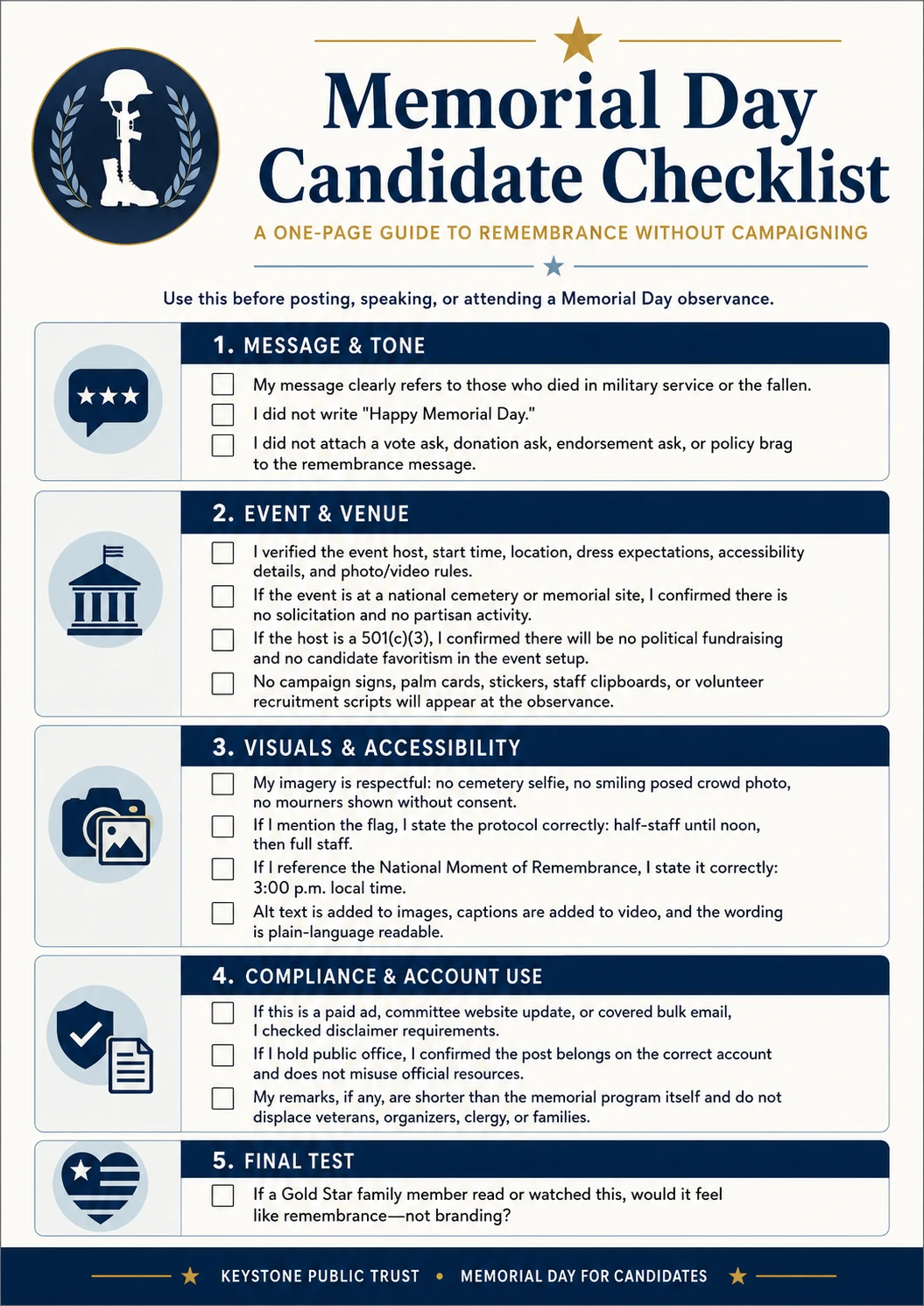
*Use this checklist before posting, speaking, or attending a Memorial Day observance.*
Frequently Asked Questions
Should a candidate say “Happy Memorial Day”?
It is better not to. Memorial Day is a day of mourning and remembrance. Use language like “we remember,” “we honor,” or “we pause to remember.”
Can a candidate attend Memorial Day ceremonies?
Yes, when attendance is respectful and the event rules permit it. The candidate should not treat the ceremony as a campaign stop.
Can a campaign post photos from a Memorial Day event?
Yes, but only if the images are respectful and permitted by the venue. Avoid cemetery selfies, visible mourners without consent, and candidate-centered photo ops.
Should a Memorial Day post mention veterans?
It can mention veterans respectfully, but the main focus should remain on those who died in military service and the families who carry that loss.
Should candidates fundraise on Memorial Day?
Do not attach fundraising to remembrance language. If the campaign must run unrelated communications that day, keep them separate and follow normal disclaimer rules.
What is the National Moment of Remembrance?
It is a national observance at 3:00 p.m. local time on Memorial Day when Americans are encouraged to pause and remember those who died in service.
A Keystone Public Trust Note
Public trust is built in moments like this. Candidates reveal seriousness not only through policy positions, but through tone, restraint, accuracy, and respect for the community’s shared civic moments.
Keystone Public Trust helps serious candidates strengthen the public-facing signals that make them look clear, credible, organized, and ready for principled public service.